Sir Bedivere
Le Morte d'ArthurSir Bedivere is a knight who serves King Arthur in both war and private expeditions, and becomes the attendant charged with carrying out the king’s final command concerning Excalibur. His place beside Arthur at the end of the story gives his loyalty a lasting significance: he is not merely present at the king’s departure, but responsible for the act that marks the passing of the sword and the old order it represents.
Service to King Arthur
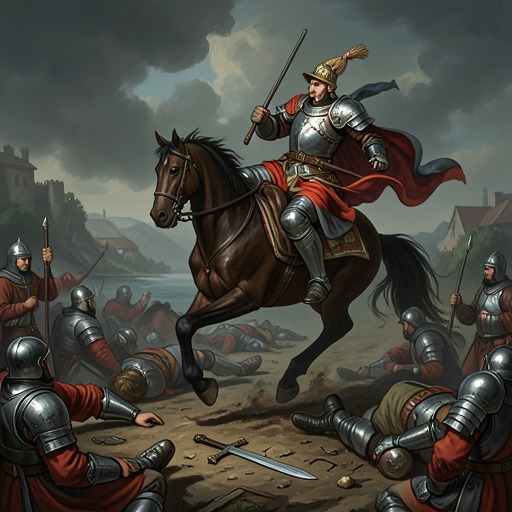
During the campaign against Rome, King Arthur chose Sir Bedivere as one of the knights sent to deliver a warning to the emperor’s forces. He rode with Sir Gawaine, Sir Bors, and Sir Lionel, with Sir Lionel and Sir Bedivere held back in ambush while Sir Gawaine and Sir Bors delivered the message. The encounter escalated into fighting; Arthur’s knights were at risk, and the account records that Sir Gawaine was badly wounded. Once the prisoners had been recovered and the Romans put to flight, Arthur’s force returned without losing a knight of renown. Sir Bedivere’s role was part of a coordinated embassy that became a military engagement, rather than an isolated feat of arms.
The expedition also shows the responsibilities attached to his service. The Roman envoys had demanded tribute from Britain on behalf of King Lucius, and Arthur had answered their demand with a promise to resist by force. The knights’ mission carried that refusal directly to Lucius: they were to require him to leave Arthur’s land or prepare for battle. Sir Bedivere thus serves within the political as well as martial work of Arthur’s court.
The Expedition to Saint Michael’s Mount
Elsewhere in the Roman campaign, Arthur learned that a giant had terrorized the countryside, killed many people, and carried off the Duchess of Brittany. Arthur secretly summoned Sir Kay and Sir Bedivere, ordering them to make ready horses and armor for a night ride. After evensong, the three set out for Saint Michael’s Mount. At its foot Arthur told his companions to wait while he climbed the hill alone to confront the danger.
The episode places Sir Bedivere among the small, trusted company Arthur selects for a hazardous undertaking, but does not make him a participant in the confrontation itself: Arthur goes up the mount alone. This distinction recurs in Bedivere’s narrative function. He is close to the king and relied upon for important service, yet the decisive action at the mount belongs to Arthur.
The Last Command and Excalibur
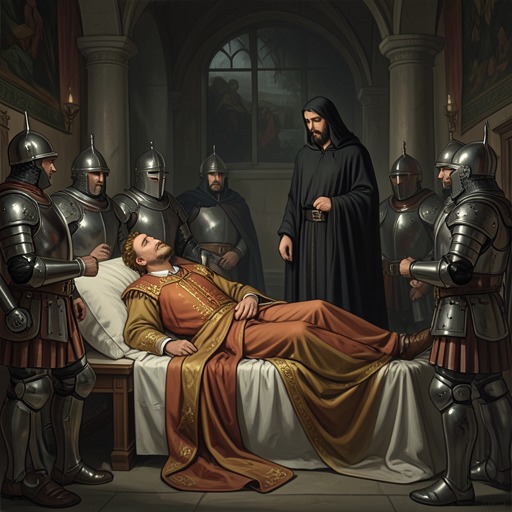
At the end of Arthur’s reign, the king, gravely wounded after the battle with Mordred, commanded that Excalibur be cast into the water. Arthur was then carried away in a barge by ladies. The following morning Sir Bedivere found him dead in an hermitage and remained there with the hermit. These events place Bedivere at the threshold between Arthur’s final departure and the confirmation of his death: the command concerning the sword precedes the king’s removal, while Bedivere’s discovery comes afterward.
The sword’s disposal is the defining act entrusted to Bedivere in the closing sequence. It makes him the intermediary between Arthur and the world left behind, charged with obeying a royal command whose importance is greater than the handling of a weapon. The narrative connects the loss of Excalibur with the king’s departure, then gives Bedivere the sobering task of discovering that Arthur has died. His service therefore culminates not in a new victory or office, but in faithful attendance at the end of the king’s life.
Narrative Role and Significance
Across these episodes, Sir Bedivere is associated with reliability and proximity to Arthur. He appears among the chosen knights on the Roman mission, accompanies the king on the journey to Saint Michael’s Mount, and is present in the final sequence surrounding Excalibur and Arthur’s death. The book’s chapter headings themselves preserve the distinction between those last events: Arthur commands the sword’s casting and is taken away in a barge; on the next morning, Bedivere finds him dead and stays with the hermit.
That pattern makes Bedivere a witness and servant at two different kinds of crisis. In the Roman campaign, his service belongs to the public defense of Arthur’s realm; in the ending, it belongs to the intimate, irreversible business of the king’s departure. The shift from mounted companion to the man who discovers the dead king gives his loyalty its final measure, without making him the agent of Arthur’s fate.